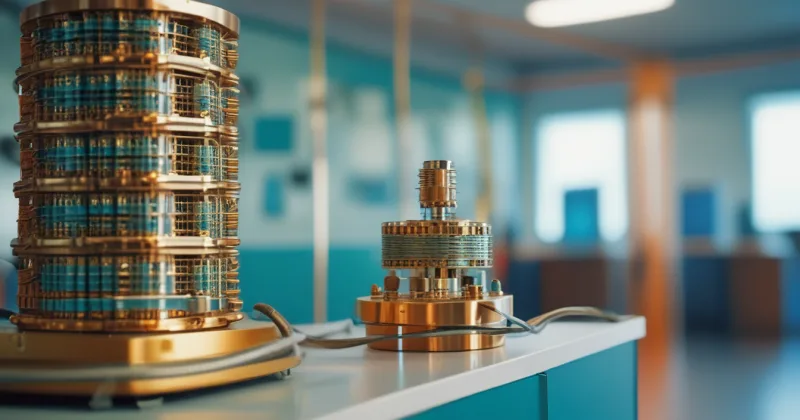
Quantinuum sets a quantum reliability record, but its machine is still too slow to threaten RSA
On the Helios computer, a protected qubit now errs only about five times per million cycles. Why this real progress does not bring the threat to today's encryption any closer.
Translated from French by AI. The original French article is the reference version.

Three errors in 29,000 trials. That is all Quantinuum's best-protected logical qubit made in a series of tests, over 20 error-correction cycles each. On October 19, the US-British manufacturer presented the result as "the most robust quantum memory ever recorded." It relies on a preprint posted on arXiv on October 16. The paper has not yet been peer reviewed.
The question that matters to security leaders is simple: should post-quantum migration be accelerated? The answer lies in another number, one the announcement highlights less: the duration of a cycle.
What Quantinuum actually measured
A physical qubit makes frequent errors. To get a reliable, or "logical," qubit, several are combined using an error-correcting code. On Helios, its 98-qubit trapped-ion machine, Quantinuum tested three code sizes, using 13, 37 and 73 physical qubits. With the largest, the error drops to about 5 in a million per correction cycle, a fidelity of 99.9995%. Each time the code grows, the error is divided by about 12 on average, according to the preprint.
Quantinuum claims this is ten times better than its own record from September, and more than a hundred times better than the best published result on superconducting chips, Google's from 2024. The company draws a projection from it, not a measurement: about 30,000 physical qubits would be needed to get 100 highly reliable logical qubits on its architecture, versus about 900,000 on a superconducting chip.
A cycle 200,000 times longer than Google's
All of this was done very slowly. According to an analysis by the specialist site PostQuantum.com, based on a figure in the preprint, one correction cycle takes about 200 milliseconds on Helios. Craig Gidney, a researcher at Google Quantum AI, first wrote 20 milliseconds, a pace he already judged "brutally slow," before correcting it to 200. Google's Willow chip completes a cycle in 1.1 microseconds, about 200,000 times faster. Helios makes fewer errors per cycle, while Willow runs far more cycles per second.
For encryption, the second point is the one that matters. Breaking a 2,048-bit RSA key takes billions of operations. The author of PostQuantum.com applied Helios's cycle time to the attack plan Gidney published in 2025. The result is about 2,700 years of computation. This is a rough personal extrapolation, since that plan assumed a different type of code. The conclusion: this result does not, on its own, bring the day RSA falls any closer. Quantinuum, for its part, makes no claim about cryptography. According to PostQuantum.com, Gidney sums up what the hardware lacks: more qubits and more speed.
What this changes for your roadmap
Nothing in the immediate term, and that is good news. The European deadlines (2030 for sensitive systems, 2035 for the rest) do not depend on a single announcement. They rest on the "harvest now, decrypt later" risk: data encrypted today can be stored and decrypted in ten or fifteen years. As after Google's progress in quantum computing, two curves must be tracked at once: reliability and speed.
The next step is set: Sol, expected in 2027, should run about twice as fast as Helios, according to PostQuantum.com. Apollo, in 2029, will be, according to Quantinuum, its first universal fault-tolerant quantum computer. Above all, we will need to check whether the 12-fold error reduction holds on much larger machines.
Method: AI-assisted monitoring, verified sources, article reviewed and approved by Frédéric LENQUETTE. Our editorial policy.
Share this article