
Citrix NetScaler (SAML): CVE-2026-107406, CVSS 9.5, possible RCE, patch to apply
On October 8, Citrix published bulletin CTX697191 (memory overflow, NetScaler ADC and Gateway) and said it is not aware of any exploitation. Any appliance configured as a SAML IdP or SP must move to the patched builds.
Translated from French by AI. The original French article is the reference version.
Key points
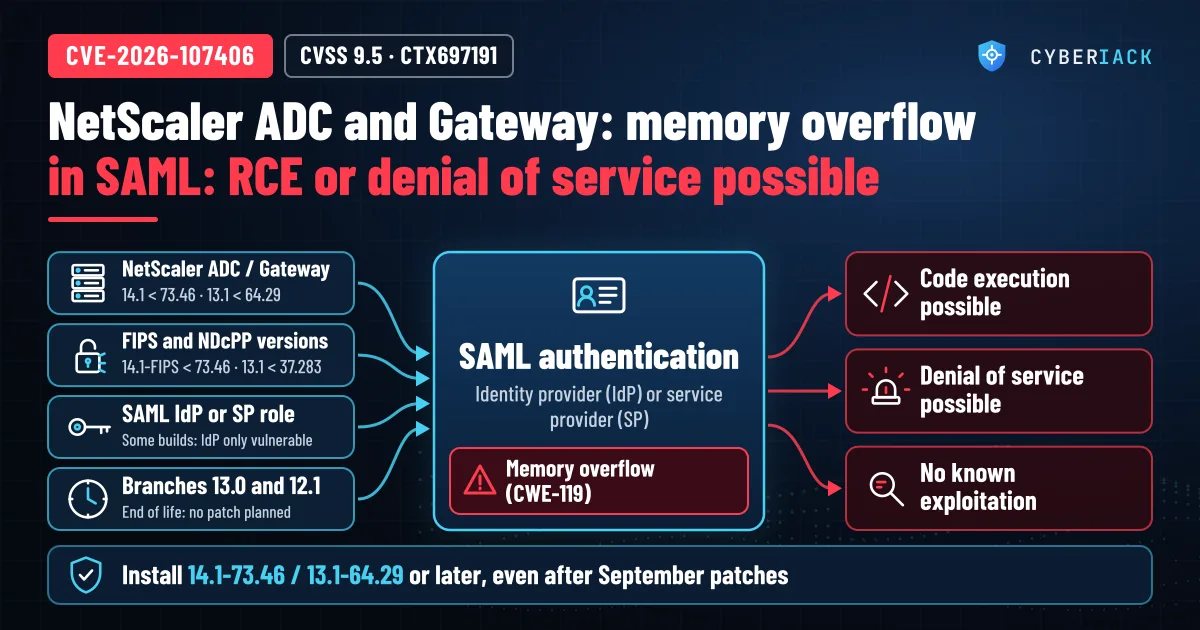
CVE-2026-107406 (CVSS v4.0: 9.5) is a memory overflow in NetScaler ADC and NetScaler Gateway that could allow remote code execution or a denial of service. Only appliances configured as a SAML identity provider (IdP) or service provider (SP) are vulnerable. The bulletin offers no workaround: install the patched builds, including on appliances already upgraded to 14.1-73.41 or 13.1-64.28.
The facts
- October 8, 2026: Citrix publishes bulletin CTX697191 (CVE-2026-107406, CWE-119, CVSS v4.0 9.5) and says it is not aware of any “unmitigated” exploitation as of the publication date.
- Exploitation condition: SAML IdP or SP role. According to The Register, older builds are vulnerable in both roles, while some newer builds are vulnerable only as an IdP.
- Patched builds (Citrix): ADC and Gateway 14.1-73.46 and 13.1-64.29; ADC 14.1-FIPS 14.1-73.46; ADC 13.1-FIPS and 13.1-NDcPP 13.1-37.283; later versions included.
- Recent builds still vulnerable: according to Poppelgaard.com, the builds released to fix the previous vulnerabilities, up to 14.1-73.41 and 13.1-64.28, remain vulnerable in the IdP role. The end-of-life 13.0 and 12.1 branches are affected and will not receive a patch.
- Related services: hybrid Secure Private Access deployments that rely on NetScaler must be updated; Citrix states that it handles updates to its managed cloud services and Adaptive Authentication itself.
- Context: CVE-2026-88771 and CVE-2026-88772 were exploited before patches were available in September 2026, and CVE-2026-88779 (denial of service) followed in early October. According to BleepingComputer, the Shadowserver Foundation counts more than 21,000 IP addresses exposed on the Internet with the NetScaler fingerprint; the number of appliances actually vulnerable has not been established.
Impact
NetScaler ADC and Gateway appliances configured for SAML are exposed. Shadowserver's count shows that a large population of these appliances is reachable from the Internet. Code execution on the appliance that handles single sign-on would give an attacker initial access to the perimeter; a denial of service would cut off the access that depends on it.
The main risk lies with recent builds: a team that deployed 14.1-73.41 or 13.1-64.28 to fix the previous vulnerabilities may believe it is up to date, while an appliance in the IdP role remains vulnerable. With three NetScaler vulnerabilities exploited since September, the absence of known exploitation as of October 8 is no reason to delay the update. For the 13.0 and 12.1 branches, migration is the only option.
Recommendations
- Identify SAML profiles, even unused ones: Poppelgaard.com suggests
grep -E \"add authentication saml(Action|IdPProfile)\" /nsconfig/ns.conf; a line containingsamlIdPProfileindicates the IdP role, the most exposed. - Install the patched builds, starting with appliances in the IdP role, including those already upgraded to 14.1-73.41 or 13.1-64.28.
- Update hybrid Secure Private Access deployments that rely on NetScaler.
- Migrate appliances running 13.0 or 12.1 to a maintained branch.
- Review the logs of appliances on which the September patches were applied late: an up-to-date appliance may have been compromised beforehand.
Method: facts verified against the sources cited below, article reviewed and approved by Frédéric LENQUETTE. Our editorial policy.
Share this article


