
Citrix NetScaler (ADC, Gateway): two zero-day RCE flaws exploited, check for compromise
On September 27, CISA flagged two zero-day RCE vulnerabilities exploited in NetScaler ADC and Gateway; as of October 9, its alert covers ten CVEs. Administrators must look for signs of compromise before patching.
Translated from French by AI. The original French article is the reference version.
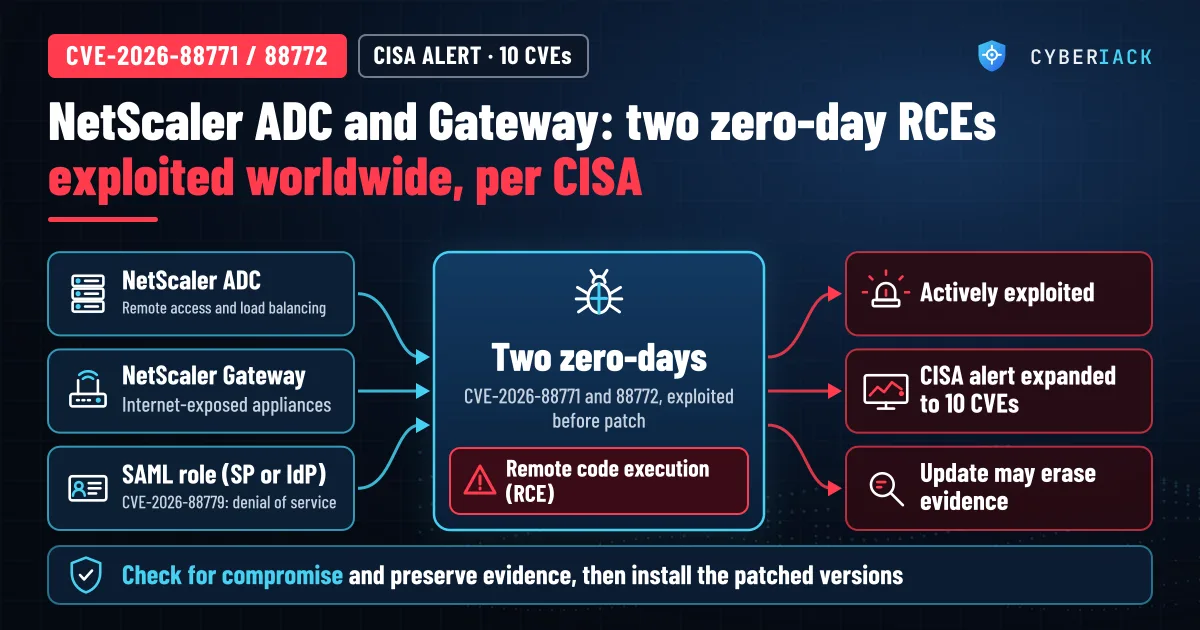
Key points
CVE-2026-88771 and CVE-2026-88772, two critical vulnerabilities in Citrix NetScaler ADC and NetScaler Gateway, each allow remote code execution. According to CISA, they are being actively exploited worldwide. Internet-exposed appliances are the top priority. CISA sets the order of operations: check for compromise and preserve evidence, then install the fixed versions listed in the Citrix bulletins as soon as possible.
The facts
- September 27: CISA flags CVE-2026-88771 and CVE-2026-88772, exploited before patches were released. Each one alone allows remote code execution.
- Citrix covers CVE-2026-88771 through CVE-2026-88778 in bulletin CTX697096, which lists the fixed versions.
- October 4: CISA adds CVE-2026-88779 to the KEV catalog. It can cause a denial of service on appliances configured as a SAML service provider or identity provider. On an unpatched system, an attacker could also use it to force a restart, which could allow code previously injected via CVE-2026-88771 to run.
- October 9: CISA adds CVE-2026-107406, which has its own separate Citrix bulletin. After several updates, its alert covers ten CVEs: CVE-2026-88771 through CVE-2026-88779, and CVE-2026-107406.
- Detection: Citrix provides indicators of compromise via NetScaler Console and a procedure for suspected compromise (CTX694799). CISA publishes SIGMA rules on its GitHub repository.
Impact
Any organization that uses NetScaler ADC or NetScaler Gateway is exposed, first and foremost on appliances reachable from the Internet. Remote code execution on these appliances gives an attacker a foothold at the edge of the information system. SAML provider configurations carry compounded risks: denial of service via CVE-2026-88779 and, without a patch, a forced restart that could activate code injected via CVE-2026-88771.
Exploitation preceded the patches: an appliance patched today may have been compromised earlier. Hence the order set by CISA, since updating can erase evidence useful to the investigation and the fast rotation of local logs shortens the investigation window. The secrets that must be renewed after a compromise (local accounts, KEK, TLS certificates) show what should be considered exposed. A compromised appliance is therefore an incident response matter, with the GDPR or NIS2 notifications that the data and services involved may require.
Recommendations
- Look for signs of compromise on every NetScaler ADC and Gateway using the indicators Citrix provides via NetScaler Console, and preserve evidence before any update.
- Install the fixed versions listed in the Citrix bulletins (CTX697096 and the separate bulletin for CVE-2026-107406) as soon as possible, starting with Internet-exposed appliances and those configured as SAML providers.
- Send NetScaler logs to a SIEM, because local logs rotate quickly, and deploy the SIGMA rules published by CISA there.
- In case of compromise, restore a clean backup from before the attack, then renew all secrets: local account passwords, key encryption keys (KEK) and TLS certificates.
- Keep an up-to-date inventory of NetScaler appliances, their exposure and their SAML role, so you can immediately apply any future extensions of the alert.
Method: facts verified against the sources cited below, article reviewed and approved by Frédéric LENQUETTE. Our editorial policy.
Share this article


