
Eneco Belgium: IBANs and EAN codes exfiltrated via “forgot password” enumeration, leak confirmed
Alerted by the Centre for Cybersecurity Belgium, Eneco confirmed the leak on November 26, including addresses, without giving its scale. Notified customers should beware of fake payment requests.
Translated from French by AI. The original French article is the reference version.
Key points
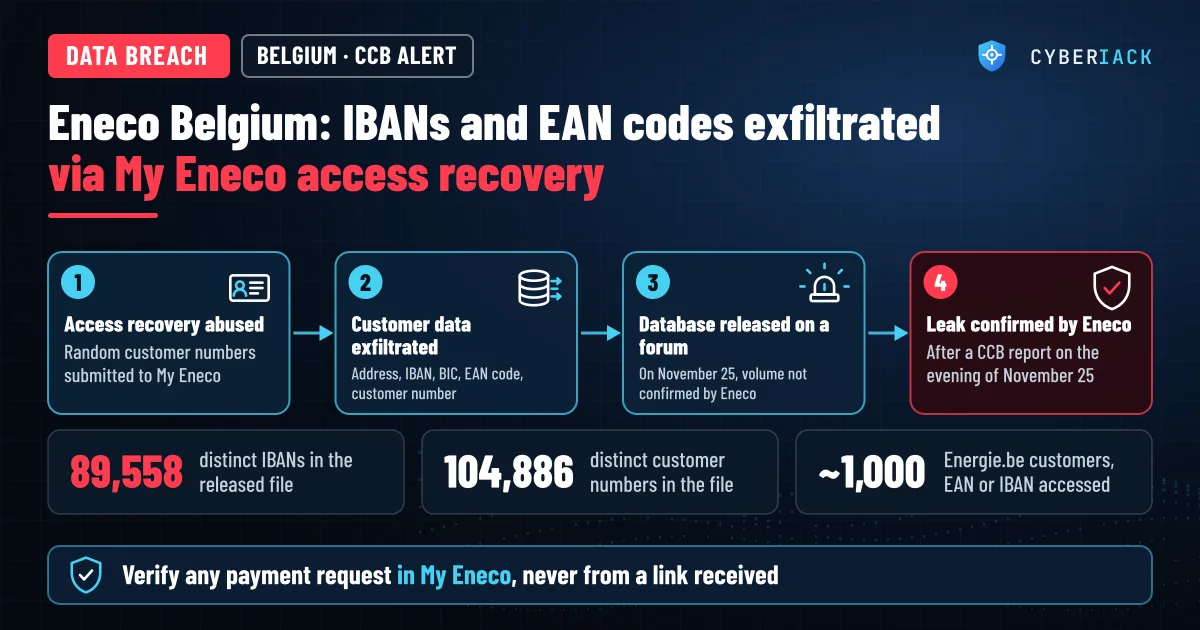
Eneco Belgium confirms that third parties obtained the customer number, address, IBAN, BIC and EAN code of some of its customers. They abused the access recovery function of the My Eneco customer portal. The supplier had denied any intrusion; it changed its position on the evening of November 25, after a report from the Centre for Cybersecurity Belgium (CCB), then confirmed the leak on November 26. Notified customers should expect credible fake payment requests.
The facts
- November 25: a cybercriminal releases a database attributed to Eneco for free, revealed by the French Breaches site. Eneco first denies it. That same evening, a spokesperson tells Belga that “the CCB informed us that customer data had apparently been stolen by malicious third parties after all.” According to the news report, the leak dates back to the previous weekend.
- Vector, according to Eneco: random customer numbers were submitted to the site's credential recovery function, which gave access to the data. Some customers thus received a genuine reset email they had not requested. Eneco says the problem is fixed (ITdaily, Dutch IT Leaders, November 26).
- Data: customer number, address, IBAN, BIC and EAN code of the connection point. According to Eneco, no name, no email address and no password were exposed, and no password change is required. Eneco does not disclose the number of affected customers and has been contacting them individually since November 26.
- Claimed volume: French Breaches counts 104,886 distinct customer numbers and 89,558 distinct IBANs in the released file. Eneco does not confirm these figures, which are not numbers of people.
- Energie.be: Luminus's subsidiary informed its affected customers of unauthorized access to some of their data. According to VRT NWS (November 26), the message lists last name, first name, address, email, phone, IBAN and invoice overview, and for about a thousand customers the access also covered EAN codes or IBANs. The customer portal was shut down, then restored. No link with the Eneco incident has been established.
Impact
An IBAN alone does not allow money to be withdrawn directly from an account. Combined with the address, customer number and EAN code that appear on an invoice, however, it makes a fake message from Eneco or a bank credible. Eneco itself cites fake payment requests and misleading contract offers. The GDPR requires a breach to be notified to the Data Protection Authority without undue delay and, where feasible, within 72 hours, unless it is unlikely to result in a risk to individuals. It also requires informing individuals when the risk is high, which Eneco has begun doing.
According to Eneco, the vector is a “forgot password” flow queried with random customer numbers. Eneco has not explained how this flow delivered the data. Any supplier, operator or insurer whose access recovery relies on a contract number should check its own.
Recommendations
- Relay Eneco's instructions to affected customers: never share a PIN, password or itsme code. Also advise them to verify any payment request in My Eneco and to forward suspicious messages to suspect@safeonweb.be.
- Monitor direct debits on exposed accounts and dispute any unknown debit with the bank.
- In companies that are customers of Eneco or Energie.be, validate by call-back any request to change bank details received in the name of these suppliers.
- Audit your own access recovery flows: identical response whether or not the identifier exists, no data returned before authentication, rate limiting per identifier and per source address.
- Search application logs for bursts of reset requests involving sequential or random identifiers.
Method: facts verified against the sources cited below, article reviewed and approved by Frédéric LENQUETTE. Our editorial policy.
Share this article


