
1Password: account data exfiltrated, vaults untouched per vendor, expect phishing
1Password disclosed on November 25 that an attacker, through an employee's GitHub account, pushed malicious code into backend services. Pending invitations and recent account recoveries should be checked.
Translated from French by AI. The original French article is the reference version.
Key points
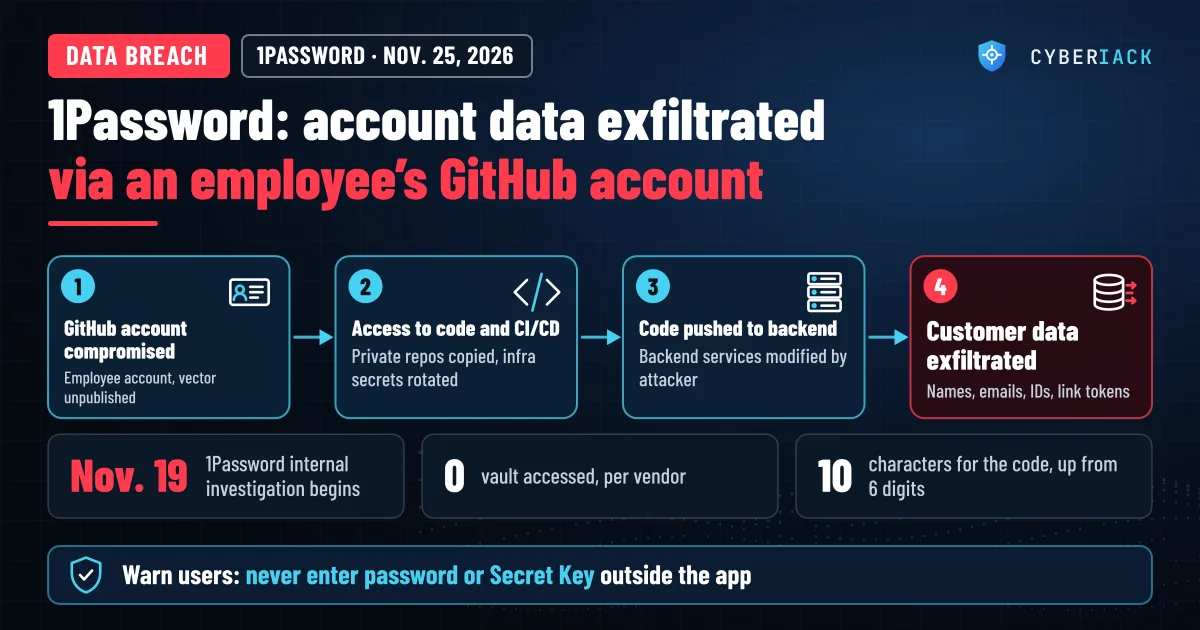
1Password disclosed on November 25, 2026 that an attacker, through an employee's corporate GitHub account, pushed malicious code into backend services that downloaded account data for some of its users. According to the vendor, vault contents and their keys were never accessible and no action is required on accounts. The immediate risk is targeted phishing, which users should be prepared for now.
The facts
- November 19, 2026: 1Password begins investigating signs that an employee's GitHub account was compromised. Neither the vector, the date of first access, nor the duration of the intrusion has been published.
- According to the vendor, the attacker accessed source code, copied private repositories, accessed the CI/CD environment and pushed malicious code into backend services, which downloaded administrative customer data.
- Data exfiltrated for "a subset" of users, with no figure given: names, email addresses, account and user IDs, creation and last sign-in dates, public keys, SRP protocol parameters, and tokens for some invitation, provisioning and recovery links sent by email.
- According to 1Password, these tokens are not sufficient on their own: SSO authentication or a code sent by email is also required, and the vendor has changed that code from six digits to ten characters. A small number of users awaiting a provisioning invitation (SCIM Bridge or Hosted Provisioning) were notified individually.
- Not affected according to the vendor: vaults and vault keys, the password and Secret Key, which it does not store, recovery keys, applications and extensions. It has found no account takeover, has rotated or revoked the exposed infrastructure secrets, and has engaged independent experts.
Impact
For stored secrets, the direct risk is low if one relies on the vendor's statement. The indirect risk is real: the attacker knows who uses 1Password, their last sign-in and, for some, a pending invitation or recovery, which is enough to write credible messages to obtain the password, the Secret Key or the verification code. The post mentions no notification to a data protection authority; European customers should find out whether their users are in scope to assess their own obligations under the GDPR.
The lesson goes beyond 1Password: a single developer account was enough to modify services that handle customer data. The vendor does not explain this point, and it is the one to check in your own organization: branch protection, mandatory review, separation between repository and deployment.
Recommendations
- Warn users: 1Password never asks for the password or the Secret Key, and any unexpected invitation, recovery or account "securing" link should be ignored in favor of signing in directly through the app.
- Review pending invitations and recent account recoveries in the admin console, and cancel any that match no legitimate request.
- Ask 1Password whether members of your account are affected and record the answer in your GDPR analysis.
- Strengthen filtering and detection of messages impersonating 1Password: lookalike domains, fake invitation or recovery links.
- Check on your own repositories that a single compromised account cannot deploy: protected branches, mandatory review, tokens with limited scope and lifetime, phishing-resistant MFA for developers.
Method: facts verified against the sources cited below, article reviewed and approved by Frédéric LENQUETTE. Our editorial policy.
Share this article


