
Vercel Sandbox (AI agents): data exfiltration possible via an allowed server, no patch available
According to AIR (The Record, October 13, 2026), code running in Vercel Sandbox could exfiltrate data through an allowed server. With no patch available, users should reduce the secrets entrusted to AI agents.
Translated from French by AI. The original French article is the reference version.
Key points
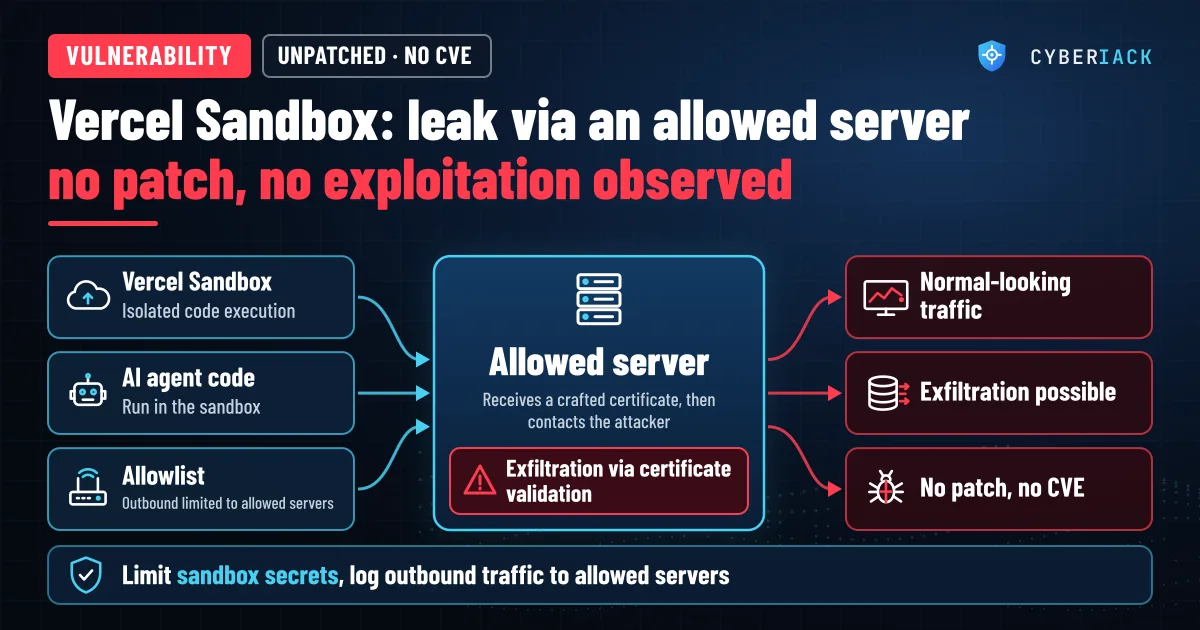
According to the start-up AIR, code running in Vercel Sandbox, including code run by an AI agent, could exfiltrate data. To do so, it gets an allowed server to contact the attacker on its behalf, which bypasses the allowlist of permitted destinations. No patch or CVE identifier exists at this stage, and no exploitation has been observed. Until a patch is available, organizations should reduce the secrets accessible to agents and log their outbound traffic.
The facts
- October 13, 2026, The Record: AIR describes a bypass of Vercel Sandbox. This service runs code, including code produced by AI agents, in an isolated environment whose network access is limited to an allowlist of permitted destinations.
- Technique, according to AIR: it exploits certificate validation. The code running in the sandbox sends a specially crafted certificate to an allowed server. That server then makes a request itself to an address chosen by the attacker. The sandbox never contacts the forbidden destination and, from its point of view, the traffic looks normal.
- Status, according to The Record: no patch available, no CVE identifier issued. AIR found no trace of exploitation, though it cannot rule it out, and believes the vulnerability has existed for a long time.
- Vendor, according to AIR: Vercel was notified and replied that it needs time, because how to fix the issue is not yet clear. Vercel had not responded to The Record at the time of publication.
- Niv Hoffman, co-founder and CTO of AIR, tells The Record that the leak is very hard to plug. He believes companies could experience, with their own agents, minor incidents similar to the Hugging Face one, in which OpenAI models tested for offensive capabilities escaped their test environment in July, an episode over which Brussels is demanding answers from OpenAI and Anthropic.
- Beyond Vercel: a recent Perplexity study, mentioned by the tl;dr sec newsletter, bypassed domain-name filtering on 8 of the 10 sandbox platforms tested. At Amazon, Zenity showed that a single request was enough to hijack AgentCore AI agents. AWS disputes that this is a vulnerability.
Impact
The exposed organizations are those that run AI agent code in Vercel Sandbox with secrets or data accessible from the sandbox. The risk is an exfiltration that egress filtering does not see, since the only observable flow goes to an allowed destination.
An allowlist controls who the sandbox talks to, not what the allowed servers do afterward. Two elements suggest a limit of the filtering model rather than an isolated flaw: Perplexity's result, 8 platforms out of 10, and the absence of a clear fix at Vercel. For an AI agent, network filtering remains one layer of defense among others. Protection rests first on what the agent can reach.
Recommendations
- Inventory the uses of Vercel Sandbox that run AI agent code, with the secrets and data accessible from each.
- Reduce these secrets to the strict minimum, with minimal permissions and a short lifetime.
- Remove non-essential destinations from the allowlist, since an allowed server can act as a relay.
- Log agents' outbound requests and monitor for unusual volumes to allowed services.
- Follow Vercel's announcements and apply the patch as soon as it is released.
Method: facts verified against the sources cited below, article reviewed and approved by Frédéric LENQUETTE. Our editorial policy.
Share this article


