NVIDIA squeezes a big open AI model onto a single PC graphics card
Called Nemotron 3.5 Bolt 74B, the model can run without the cloud on a computer with a 24 GB graphics card. What it enables, and why its performance claims still need to be verified.
Translated from French by AI. The original French article is the reference version.
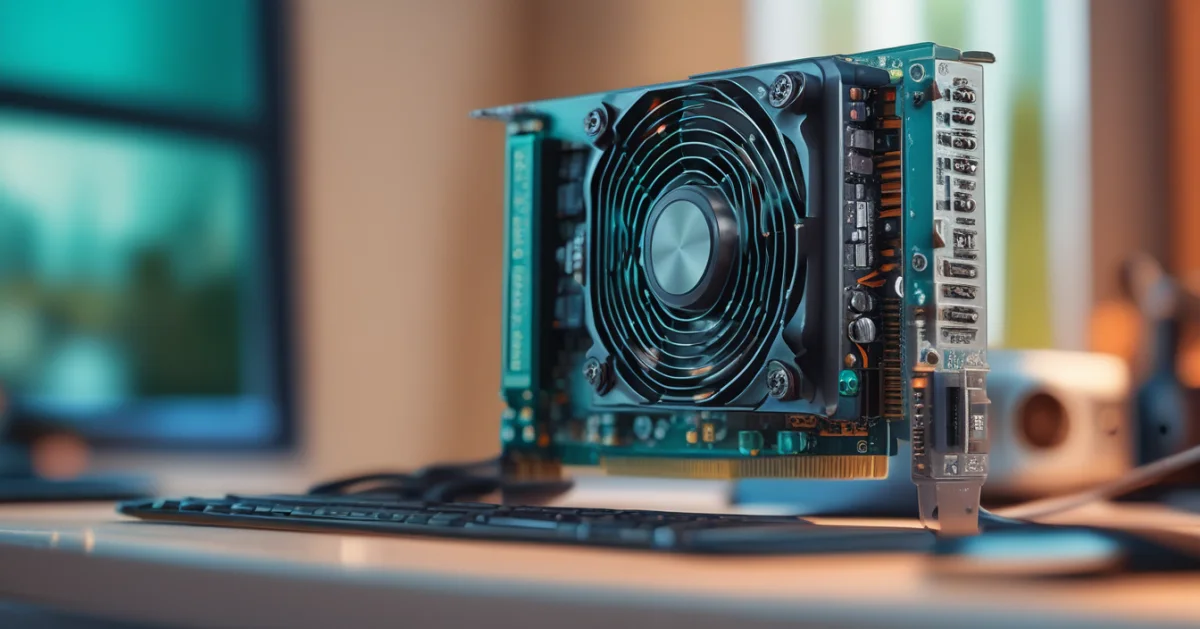
24 GB. That is the memory of a high-end consumer graphics card, and it is where NVIDIA fits an open AI model with 74 billion parameters, Nemotron 3.5 Bolt 74B-A9B. On October 15, the company released a new family of open models, Nemotron 3.5. It targets agents, meaning assistants that chain actions on their own, such as searching the web, writing code or using a terminal.
Two models are available now: Nemotron 3.5 Super VL (120 billion parameters, it also understands images) and Nemotron 3.5 Bolt 74B-A9B, designed to run on a workstation. A third, Bolt E4B, which fits in 4 GB, is announced for October 23. One question remains that this launch does not settle: are these models as good as NVIDIA claims?
How to fit a large model on a PC
Bolt 74B has 74 billion parameters, of which about 9 billion are active at each step (an architecture known as "mixture of experts"). NVIDIA natively quantized its experts to 2 bits, then used quantization-aware distillation to preserve accuracy. The result: it fits in 24 GB of memory. According to its Hugging Face model card, it accepts up to 256,000 tokens of context and supports French, although English and code remain its main languages.
It is compatible with the main local-execution tools: llama.cpp, Ollama, LM Studio, Unsloth and vLLM. NVIDIA is promoting it for its RTX Spark laptops, expected on October 16. It also runs on GeForce RTX PCs and DGX Spark workstations.
An open license and published data
Bolt 74B is released under the OpenMDW-1.1 license, which allows commercial use according to the model card. NVIDIA also publishes training datasets and its "recipes." For Super VL, the company reports about 26 trillion pre-training tokens. Super VL is available on Hugging Face, OpenRouter and ModelScope, and as an NVIDIA NIM microservice; Bolt 74B is offered on Hugging Face. Another open model is expected this month: Mistral Large 4, whose weights Mistral AI will publish on October 27.
Performance that still needs to be verified
Back to the opening question. The performance figures come from NVIDIA. The company presents Bolt 74B as the top open model in its category on PinchBench and second on BrowseComp. It says Super VL is about five times faster than the best competitor in its category, basing that speed claim on an Artificial Analysis chart. As of the evening of October 15, we found no independent evaluation of Bolt.
NVIDIA's own model card qualifies the picture. It compares Bolt with Qwen3.6-35B-A3B and Gemma 4 26B-A4B, and both of those models beat it on some lines, including PinchBench for Qwen3.6-35B-A3B (88.07 versus 87.82).
Key takeaways:
- For a company that does not want to send its data to the cloud, running an agent of this size on a single workstation becomes feasible.
- 2-bit compression can degrade some tasks: test the model on your own use cases before deploying it.
- A local agent that executes commands must stay isolated (container, limited privileges): it remains exposed to prompt injection like any other agent.
- According to its model card, Bolt's training data collection stops on February 24, 2026, and its post-training data collection in May 2026.
Method: AI-assisted monitoring, verified sources, article reviewed and approved by Frédéric LENQUETTE.
Share this article