
Godot & Fils: customer data compromised, at least €765,000 in gold handed to fake police officers
According to RTL and France Télévisions, fake police officers have been targeting the dealer's customers since August, using their compromised purchase history. Any business selling valuable goods should treat this history as sensitive data.
Translated from French by AI. The original French article is the reference version.
Key points
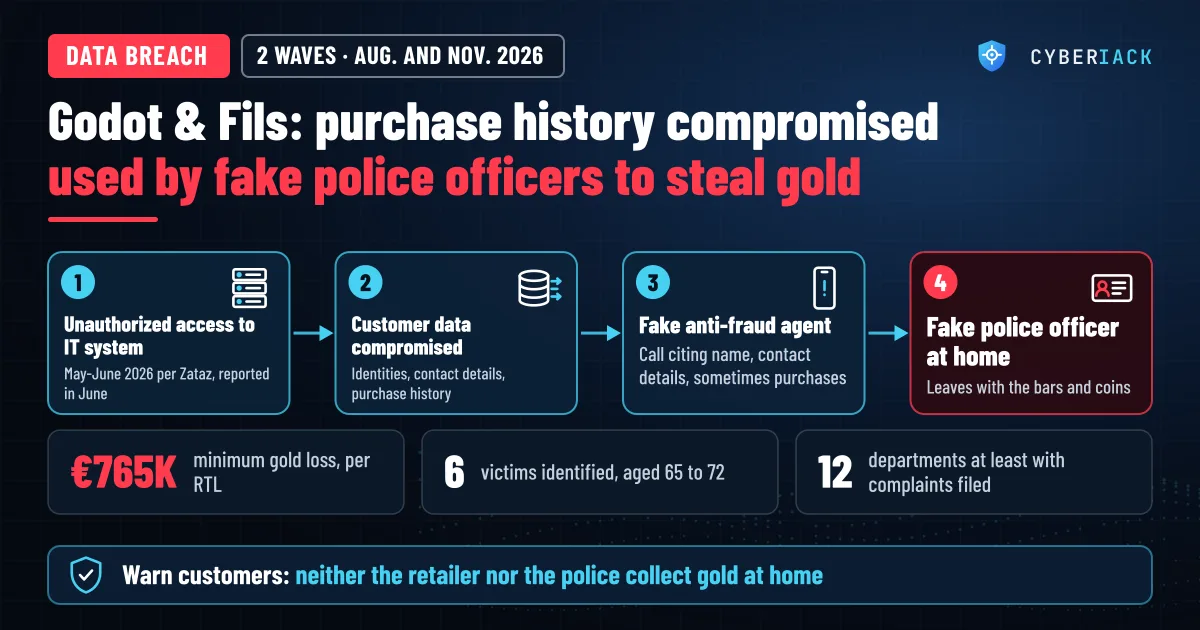
Godot & Fils customer data was compromised in an intrusion reported in June 2026. Since August, it has been used in fake police scams: at least €765,000 in gold has been handed over, according to RTL and France Télévisions. Until the scope of the leak is confirmed, every customer of the company is a potential target and should be warned.
The facts
- June 2026: Godot & Fils, which also sells online under the name Achat Or et Argent, informs its customers by email of "unauthorized access to part of our information system," according to France Télévisions. Zataz places the compromise between May and June.
- June 24 and July 3, 2026: the company first claims the data was "accessed but not leaked," then specifies that identities, contact details and transaction history are affected, but not bank details, passwords or identity documents.
- Data obtained by the press: France Télévisions says it obtained names, phone numbers, email and postal addresses, as well as order details and amounts, as reported by cyberattaque.org. The 8 p.m. news on France 2 says 50,000 people may have been affected; the company has not released a figure.
- Modus operandi: a fake anti-fraud agent calls the target, quoting their name, contact details and sometimes their purchases, claims the company has been compromised and announces that a police officer will visit. A fake police officer then leaves with the bars and coins.
- November 16 and 17, 2026: RTL puts the loss at no less than €765,000. France Télévisions identifies the company and reports six victims aged 65 to 72, complaints in at least twelve départements and two waves, in August and then November. The toll remains provisional.
Impact
The fake police scam is not new. The purchase history gives it a precision that makes it credible. According to France Télévisions, Cyril Mancone of the Alliance Police nationale union considers this pairing with a data breach "fairly unprecedented." The same lever was used against customers of the Swiss Reka holiday villages.
A file without bank details or passwords is therefore far from harmless: a gold purchase history tied to an address points to the households likely to keep gold at home. For the data controller, such a personal data breach must be notified to the CNIL (the French data protection authority) within 72 hours. It also requires informing the people concerned, since the high risk has materialized here.
Recommendations
- Warn every affected customer directly, including by mail, with the message from the company's statement quoted by France Télévisions: "We never ask our customers to move, transport or hand over the gold they keep at home."
- Remind customers what to do: hang up, call the company back at the number on its official website, hand nothing over at the door, dial 17 if in doubt, file a complaint. The Interior Ministry's Ma Sécurité platform points out that a real police officer never asks anyone to hand over valuables.
- Treat any unauthorized access as exfiltration until log analysis has established otherwise.
- Classify transaction history and postal addresses as sensitive data: restricted access, logging of extractions, limited retention period.
Method: facts verified against the sources cited below, article reviewed and approved by Frédéric LENQUETTE. Our editorial policy.
Share this article


