
GitLab CE/EE (CI/CD): unauthenticated code execution, CVSS 10, patches to apply
On October 12, 2026, GitLab fixed 24 vulnerabilities, including CVE-2026-97229 (CVSS 10), unauthenticated code execution via CI/CD. Self-managed instances should be upgraded to 19.4.2, 19.3.4 or 19.2.8.
Translated from French by AI. The original French article is the reference version.
Key points
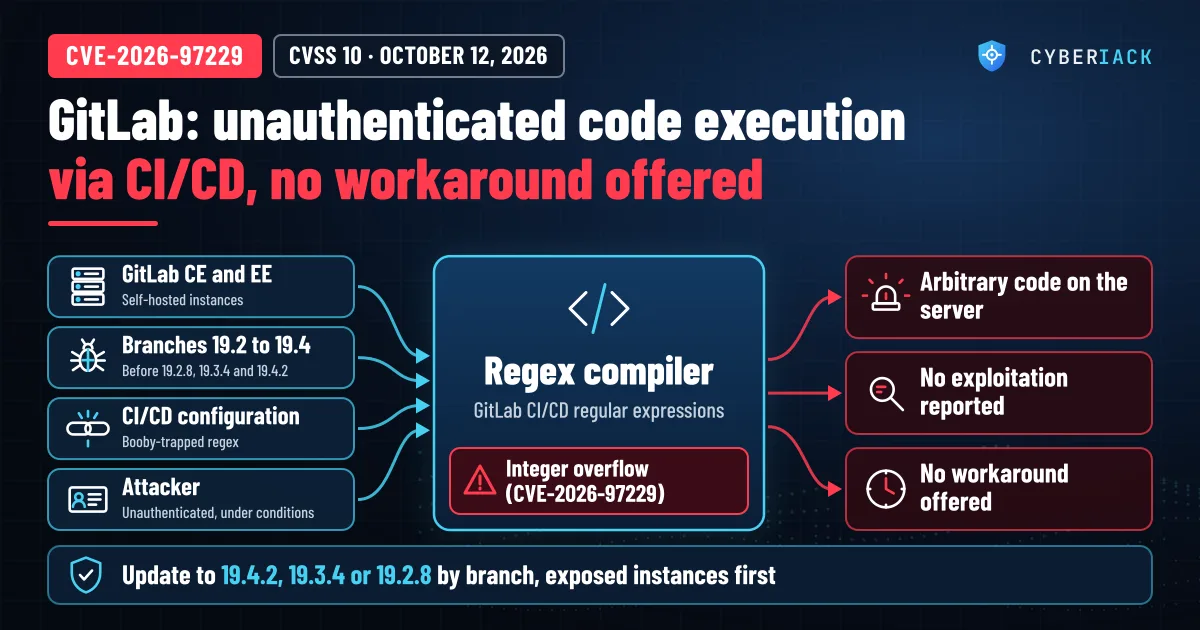
On October 12, 2026, GitLab released the patch versions 19.4.2, 19.3.4 and 19.2.8 of its CE and EE editions, fixing 24 vulnerabilities. The most severe, CVE-2026-97229 (CVSS 10), could allow an unauthenticated user to execute arbitrary code on the server, according to the vendor. GitLab offers no workaround and recommends updating self-managed instances immediately.
The facts
- October 12, 2026: GitLab releases versions 19.4.2, 19.3.4 and 19.2.8; CERT-FR (the French government CERT) publishes advisory CERTFR-2026-AVI-1294 the same day.
- CVE-2026-97229, CVSS 10: integer overflow in the CI/CD regular expression compiler. According to GitLab, a specially crafted regular expression in a CI/CD configuration could allow an unauthenticated user to execute arbitrary code on the server, “under certain conditions,” which are not specified. Reported by researcher joaxcar via HackerOne.
- Affected versions, according to GitLab: 19.2 before 19.2.8, 19.3 before 19.3.4, 19.4 before 19.4.2. The bulletin reports no exploitation as of its publication date.
- Five other high-severity vulnerabilities, according to the same bulletin: XSS in syntax highlighting (CVE-2026-92883, 8.7); authorization flaw in downstream pipeline creation (CVE-2026-16301, 8.5); cache poisoning related to repository file access (CVE-2026-14814, 8.2); authorization flaw in scheduled pipeline execution policies, EE (CVE-2026-81839, 7.7); prompt injection in GitLab Duo Agent Platform, EE (CVE-2026-96893, 7.3).
- The other fixes mainly concern authorization checks: GraphQL API, package registry, access tokens.
- According to GitLab, GitLab.com is already patched and GitLab Dedicated customers need to take no action.
Impact
Self-managed CE and EE instances on branches 19.2 to 19.4 that have not been updated are exposed. A GitLab server holds source code, CI/CD configurations and pipeline secrets: code execution on this server gives access to the build and deployment chain, and therefore to the software the organization produces and ships. Since the exploitation conditions are not detailed, no configuration can be considered out of reach.
CVE-2026-96893 brings prompt injection into the forge's patch cycle: the AI agents of Duo Agent Platform now fall under vulnerability management.
Recommendations
- Update each self-managed instance to 19.4.2, 19.3.4 or 19.2.8 depending on its branch, starting with Internet-facing instances.
- Plan the downtime: database migrations make a single-server instance unavailable; multi-node architectures can follow the zero-downtime upgrade procedure.
- Warn users of the Ona integration on the 19.3 branch: 19.3.4 contains a bug affecting merge request pages, with a fix planned in 19.3.5.
- Review the logs of instances that remained vulnerable: changes to CI/CD configurations, unexpected pipelines, processes launched by the GitLab service.
- Rotate CI/CD secrets and access tokens on any instance where doubt remains.
- Inventory GitLab instances, including those outside the CIO's scope, and permanently restrict network access to their interface.
Method: facts verified against the sources cited below, article reviewed and approved by Frédéric LENQUETTE. Our editorial policy.
Share this article


