
FortiMail (CVE-2026-104286, CVSS 9.8): vulnerability exploited, patches to apply
On October 1, Fortinet reported a FortiMail vulnerability exploited before a patch was available, now in the KEV catalog. Non-Cloud instances should move to 8.0.2, 7.6.7 or 7.4.9; the 7.2 branch must migrate.
Translated from French by AI. The original French article is the reference version.
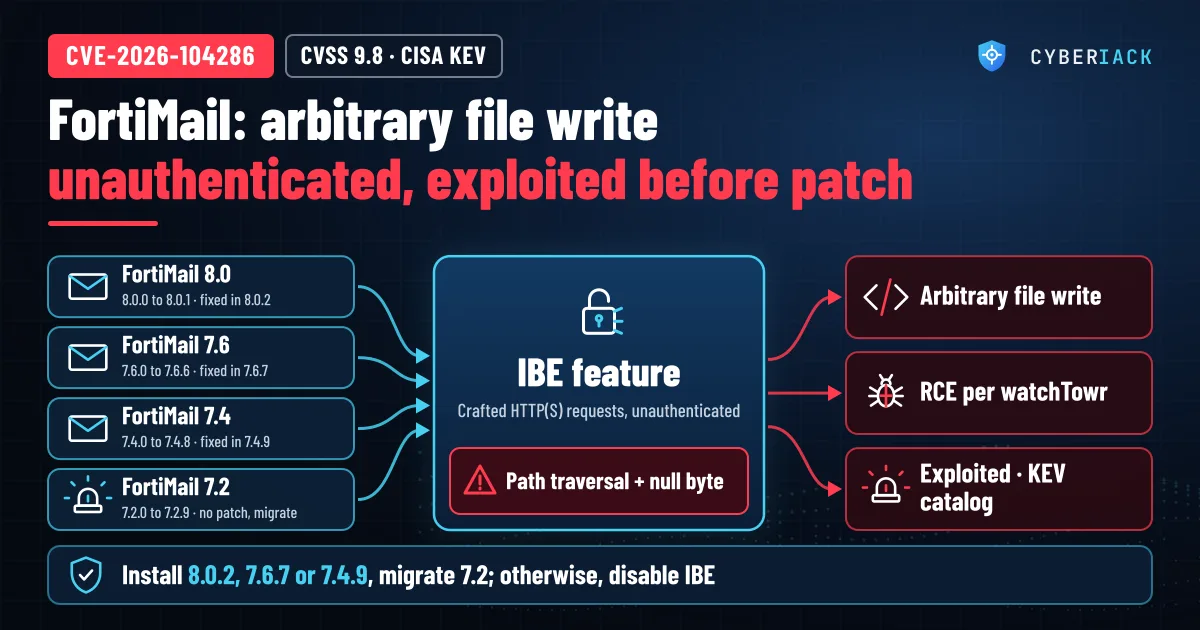
Key points
Vulnerability CVE-2026-104286 (CVSS 9.8) allows an unauthenticated attacker to write arbitrary files to a FortiMail gateway. It was exploited before any patch was available and has been in CISA's KEV catalog since October 1, 2026. Install 8.0.2, 7.6.7 or 7.4.9 without delay, migrate 7.2 appliances, and look for signs of compromise on those that were exposed.
The facts
- October 1, 2026: Fortinet publishes advisory FG-IR-26-175 and reports active exploitation. CISA adds the vulnerability to its KEV catalog the same day. It was discovered by Fortinet's product security team.
- Nature: path traversal combined with improper handling of the null byte. Crafted HTTP or HTTPS requests allow arbitrary files to be written without authentication. According to watchTowr researchers, this write is then enough to execute commands on the appliance.
- Versions (advisory FG-IR-26-175): 8.0.0 to 8.0.1, fixed in 8.0.2; 7.6.0 to 7.6.6, fixed in 7.6.7; 7.4.0 to 7.4.8, fixed in 7.4.9. No patch is planned for the 7.2 branch (7.2.0 to 7.2.9): migrate to 7.4.9 or a later version.
- Availability: announced as "upcoming" when the advisory was published, the fixed versions are listed as available since its October 5 update (release notes dated October 2 for 7.6.7, and October 3 for 8.0.2 and 7.4.9). Fortinet patched FortiMail Cloud instances itself.
- Indicators of compromise (Fortinet advisory, BleepingComputer): files
/data/lib/liblog.so,/data/etc/ld.so.preload,/data/bin/webconsoleand/data/bin/mailservice; archive accountarchive234pointing to a remote server; connections from 79.141.169.187 and 45.129.0.192; scheduled task linked to/migadmin; unusual IBE (identity-based encryption) decryption errors.
Impact
Non-Cloud FortiMail appliances that have not been updated are exposed, especially those whose webmail interface is reachable from the Internet. The entire 7.2 branch is also exposed: until it is migrated, only the workaround protects it. Because exploitation preceded the patches, an appliance exposed before its update may have been compromised, and updating alone does not guarantee its integrity.
A mail gateway sees all of an organization's communications. The archive234 account points to possible exfiltration of archived emails. If it is present, the incident is likely a personal data breach, to be reported to the CNIL (the French data protection authority) within 72 hours if it poses a risk to individuals.
Recommendations
- Install 8.0.2, 7.6.7 or 7.4.9 depending on the branch, and schedule without delay the migration of 7.2 appliances to 7.4.9 or a later version.
- In the meantime, apply Fortinet's recommended workaround: disable IBE (
config system encryption ibe,set status disable,end) or, failing that, remove the webmail interface from the Internet or restrict it to trusted networks. Behind a WAF, block POST requests to/ibecontaining../. - Look for the indicators listed above on each appliance: files under
/data, declared archive accounts, scheduled tasks, connections from the two IP addresses in the logs, IBE decryption errors. - Treat any suspicious appliance as compromised: preserve the evidence, reinstall it, change the associated secrets, then assess the exfiltration of archived emails and the notification obligation.
- Also remove the administration interface from the Internet, as a precaution.
Method: facts verified against the sources cited below, article reviewed and approved by Frédéric LENQUETTE. Our editorial policy.
Share this article


