
École 42: up to 140,000 profiles exfiltrated via a legitimate account, incident confirmed
On October 9, 2026, the directory of École 42's intranet was put up for sale on a cybercriminal forum; the school acknowledged the incident. Students, applicants and staff should expect targeted phishing.
Translated from French by AI. The original French article is the reference version.
Key points
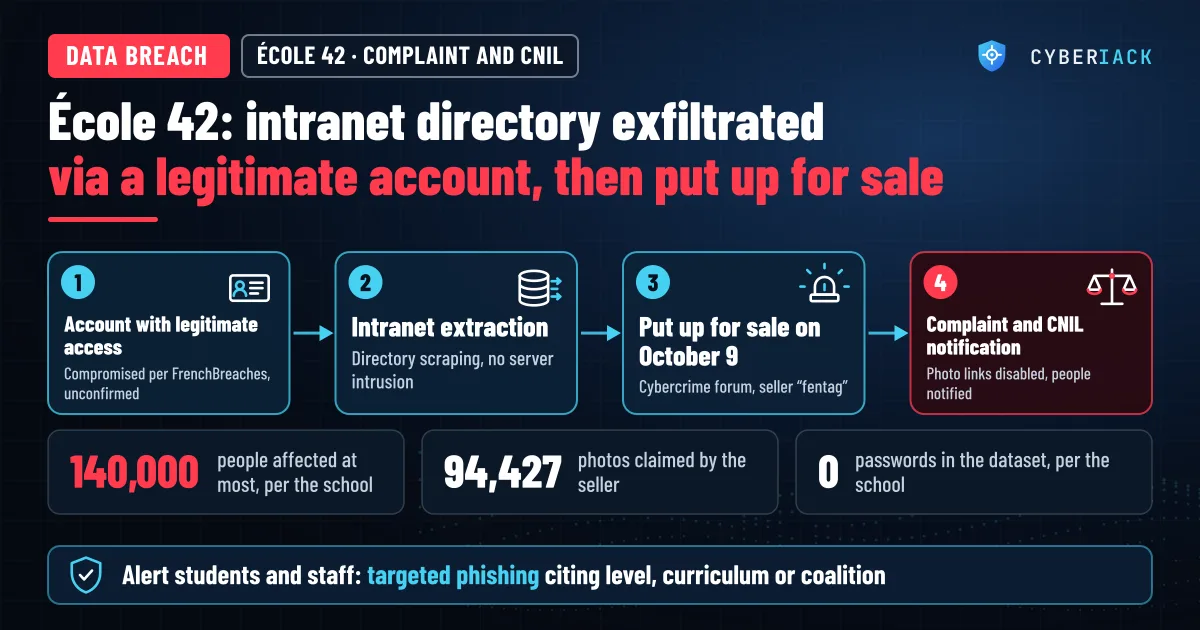
École 42 has acknowledged the leak of its internal directory, put up for sale on October 9, 2026. According to the school, up to 140,000 people may be affected. Based on the initial findings of its investigation, the data was extracted from the intranet using an account with legitimate access, without any intrusion into the servers. The school says the data set contains no passwords. The immediate risk is targeted phishing against students, applicants and staff.
The facts
- October 9, 2026: a seller using the handle “fentag” puts a file on sale on a cybercriminal forum, presented as the École 42 directory. The seller claims 140,080 profiles and 94,427 photos, collected the day before. These figures cannot be verified, and a record does not necessarily match a distinct person.
- Confirmation: according to Fuites Infos, the school acknowledges the incident and estimates that up to 140,000 people may be affected, across several campuses of its network. Students of 42 Next are reportedly not affected.
- Vector: according to the initial findings of the school's investigation, reported by Fuites Infos, this was automated extraction (scraping) of the intranet using a user account that had legitimate access to it, in breach of the terms of use. According to FrenchBreaches, this student account was first compromised, then blocked the next day, after the data had been copied. The school has not confirmed this point.
- Data, according to the school: last names, first names, student email addresses and login identifiers; level, curriculum, grades, “coalition” (internal team) and “wallet” (the platform's virtual currency, with no banking data); links to profile photos. The school states that no password is included in the data set. Clubic and FrenchBreaches did not find any either.
- Sample: the 1,000 profiles analyzed by Fuites Infos include applicants to the “piscine” (selection period), students, staff members and test accounts.
- Measures, according to Fuites Infos: students and piscine applicants notified by email, complaint filed, notification to the CNIL (the French data protection authority) under way, links to profile photos disabled. The school says it has seen, so far, neither publication of the data nor malicious use.
Impact
The data set combines identity, email address, login identifier and educational details. An attacker can use it to write credible messages in the name of a campus, the IT department or a recruiter. Valid identifiers also make password spraying attempts possible. The presence of staff accounts extends this risk to the school's information system. This is a personal data breach under the GDPR, and the notification to the CNIL is under way.
The case shows the limit of an access control that does not measure volume: according to the school, one authorized account was enough to extract the directory. Any organization that opens a rich directory to all its users runs the same risk, whether the account holder abuses their access or the account is compromised.
Recommendations
- Warn students, applicants and staff that a message citing their level, curriculum or coalition proves nothing about its sender, and that no intranet credential is ever shared.
- Search the authentication logs of the intranet and linked services for attempts targeting the exposed identifiers: series of failures, logins from unusual sources.
- Enforce MFA on intranet accounts, starting with staff accounts, and remind users that the platform password must not be used on any other service.
- Apply per-account rate limits to the directory and its interfaces, and trigger an alert beyond a threshold of records viewed.
- Reduce what the directory shows to each account: grades and photos do not need to be readable by all users.
Method: facts verified against the sources cited below, article reviewed and approved by Frédéric LENQUETTE. Our editorial policy.
Share this article


