
curl (HTTP/2): use-after-free CVE-2026-92392, RCE under conditions, upgrade to 8.23.0
On October 14, curl 8.23.0 fixed CVE-2026-92392, an HTTP/2 use-after-free affecting versions 8.12.0 to 8.22.0. Embedded copies of libcurl (in software, containers, firmware) must be inventoried and updated.
Translated from French by AI. The original French article is the reference version.
Key points
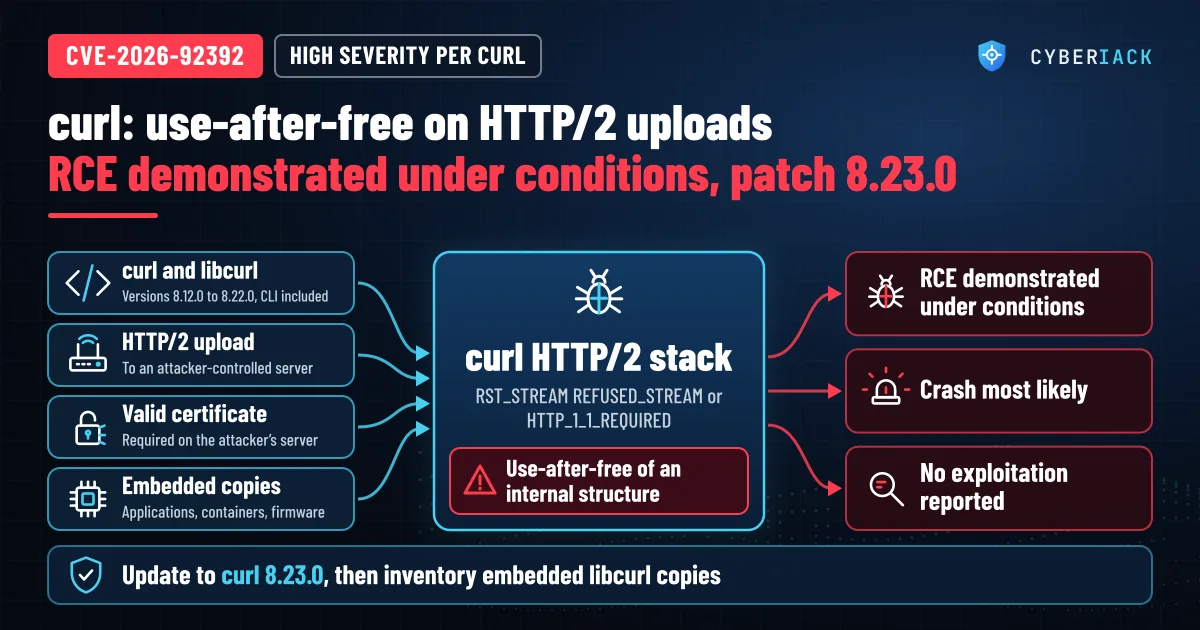
CVE-2026-92392, a use-after-free rated high severity by the curl project, affects the command-line tool and the libcurl library in versions 8.12.0 to 8.22.0 when uploading data over HTTP/2. Remote code execution has been demonstrated under restrictive conditions; no exploitation is reported. Upgrade to 8.23.0, released on October 14, 2026, and inventory embedded copies of libcurl, which a system update does not fix.
The facts
- Vulnerability (curl project advisory): when a server interrupts an HTTP/2 upload with a
RST_STREAMframe carrying theREFUSED_STREAMorHTTP_1_1_REQUIREDerror code, curl frees an internal structure that is still in use. - Versions: 8.12.0 to 8.22.0 are affected, including the command-line tool; the fix is in 8.23.0, released on October 14, 2026. On the maintained branches, versions 8.20.2, 8.16.2 and 8.14.3 are not affected.
- Exploitation conditions (advisory): the victim must upload data to an attacker-controlled server with a valid certificate. Escalation to remote code execution has been demonstrated, provided the exact version and architecture, the precise memory layout and predictable nghttp2 and OpenSSL behavior are known.
- Maintainer's assessment: Daniel Stenberg, curl's founder, adds on his blog that an upload of about 135 KB and a payload of about twenty bytes are required. In his view, the most likely outcome is a crash, and a successful attack is unlikely. Neither the advisory nor the blog mentions exploitation.
- Discovery: report dated September 15, 2026, credited by the advisory to “Luna with Claude, Anthropic”. According to Daniel Stenberg, Luna Tong, of Anthropic, found it using “OSS Scanner”, a new Anthropic tool. Fix by Stefan Eissing.
- Release: the release cycle was shortened by two weeks, from eight to six weeks, to ship the fix. Version 8.23.0 also removes support for the SMB protocol.
Impact
The direct risk remains limited: the target must be induced to upload data over HTTP/2 to an attacker's server, and the attacker must then know the environment precisely to go beyond a crash. The exposure comes from the spread of libcurl in applications, container images and firmware, which do not follow system updates and depend on each vendor's schedule. On firmware, version and architecture are often identical from one device to another: this is where the exploitation conditions are easiest to meet.
The advisory credits an AI-assisted discovery, with a named finder and a report date; other attributions to AI remain unverifiable, such as Vghost, a Linux kernel vulnerability whose discovery Tencent attributes to its AI. Daniel Stenberg acknowledges that a memory-safe language would probably have prevented this bug, but rules out rewriting curl.
Recommendations
- Update curl and libcurl to 8.23.0, or to 8.20.2, 8.16.2 or 8.14.3 on the maintained branches, starting with systems that upload data over HTTP/2 to external servers.
- Inventory the software, container images and firmware that embed libcurl (software inventory, SBOM, image scanning), then track each vendor's updates.
- Disable HTTP/2 in curl where the update has to wait: this is the only workaround the project indicates.
- Before updating, check whether any workloads use curl with SMB, and plan a replacement solution.
Method: facts verified against the sources cited below, article reviewed and approved by Frédéric LENQUETTE. Our editorial policy.
Share this article


