
AP-HP (Dedalus meal software): 1,015 patient identities exfiltrated, more claimed
On October 7, AP-HP confirmed the exfiltration of the identities of 1,015 patients via SRD Restauration (Dedalus), its meal-ordering software. Healthcare facilities should inventory their exposed ancillary services.
Translated from French by AI. The original French article is the reference version.
Key points
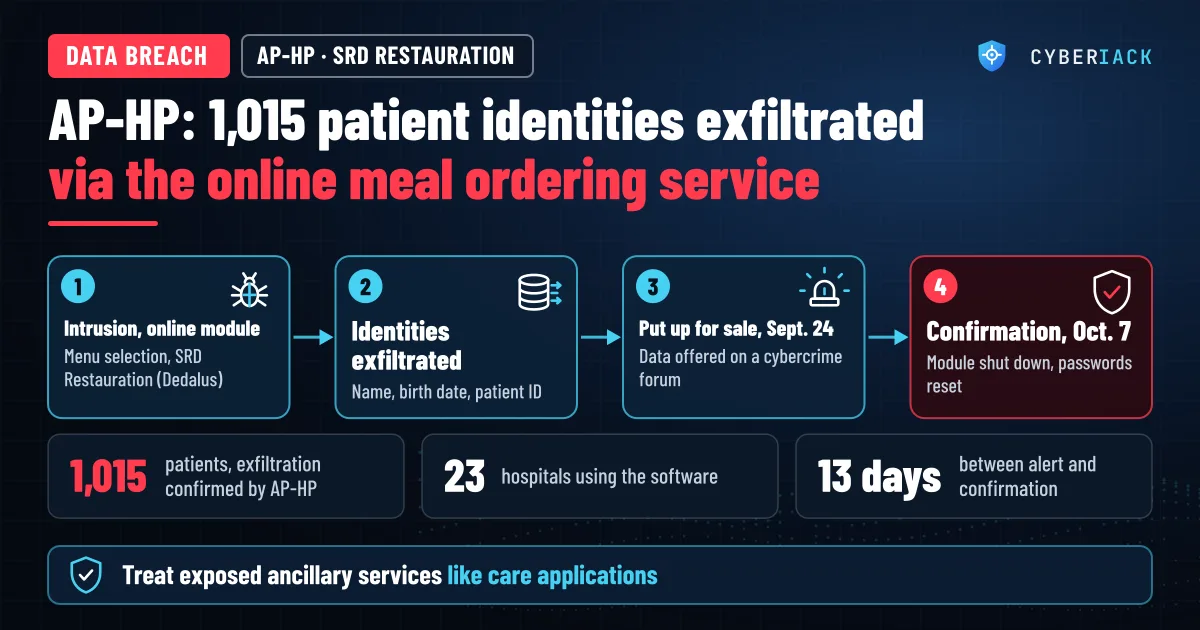
On October 7, 2026, AP-HP (the Paris public hospital network) confirmed the exfiltration of identity data on 1,015 patients through the online service of SRD Restauration, a meal-ordering software published by Dedalus and deployed in 23 of its hospitals. The attackers claim more patients and professional accounts are affected, which AP-HP does not confirm at this stage. For healthcare facilities, the action is to check now that their ancillary services exposed to the Internet are inventoried, authenticated and monitored.
The facts
- September 24, 2026: AP-HP is alerted that data from one of its software products is for sale on a cybercriminal forum. According to its statement, the intrusion took place a few days earlier, in the online module where hospitalized patients choose their menus.
- October 7, 2026: after an investigation by its digital services department with its partners and the authorities, AP-HP confirms the exfiltration of the last name, first name, birth information and internal patient ID number of 1,015 patients.
- According to AP-HP, given the nature of the software, no direct or indirect medical data, no administrative or banking information and no contact details are believed to be affected. The investigation is ongoing.
- Claimed, not confirmed: on the forum, the perpetrators cite a higher number of patients and data from the accounts of AP-HP professionals who use the software. AP-HP is verifying these claims.
- Measures announced by AP-HP: online module closed until further notice, passwords of all users reset, suspected vulnerabilities patched with its suppliers, the CNIL (the French data protection authority) and the cybersecurity support unit for healthcare organizations informed, and a complaint filed the day after the alert.
- Precedents: a data leak exposed the data of more than one million people in 2021, according to 01net; a claim concerning the electronic patient record, in mid-December 2025, was dismissed in January for lack of evidence, according to Clubic.
Impact
Patients hospitalized in the 23 facilities equipped with the software are exposed. Identity, birth information and a stay at AP-HP are enough to make a phishing attempt or a fraudulent call about a hospitalization, an invoice or a reimbursement credible, as after the data leak at Vacaf, the CAF family allowance funds' vacation aid program. If the claimed professional accounts are confirmed, the scope extends to staff.
The vector is neither the patient record nor billing, but a convenience module open to the Internet, supplied by a third-party vendor, which nonetheless handles patient identities. This is the attack surface most easily left out of scope: it requires the same inventory, the same authentication, the same monitoring and the same contractual commitments as care applications.
Recommendations
- Inventory the ancillary services open to patients on the Internet, especially those supplied by third-party vendors, and include them in the security perimeter.
- If SRD Restauration is in use, obtain from Dedalus the nature of the vulnerabilities patched and the version to deploy.
- Search the logs of these modules for abnormal logins and extractions since September 2026, then reset the passwords of professional accounts.
- Require MFA on these modules for professional accounts, logging forwarded to the SIEM and, by contract, incident notification by the vendor.
- Warn patients and staff about phishing attempts mentioning a hospitalization, an invoice or a reimbursement.
Method: facts verified against the sources cited below, article reviewed and approved by Frédéric LENQUETTE. Our editorial policy.
Share this article


