
Optimizely: skimmer injected at 178 customers, including Air France and Ledger, projects to be audited
On November 16, compromised Optimizely scripts served a skimmer and a clipper on the websites of 178 organizations, according to StepSecurity. Optimizely customers must audit their projects and access.
Translated from French by AI. The original French article is the reference version.
Key points
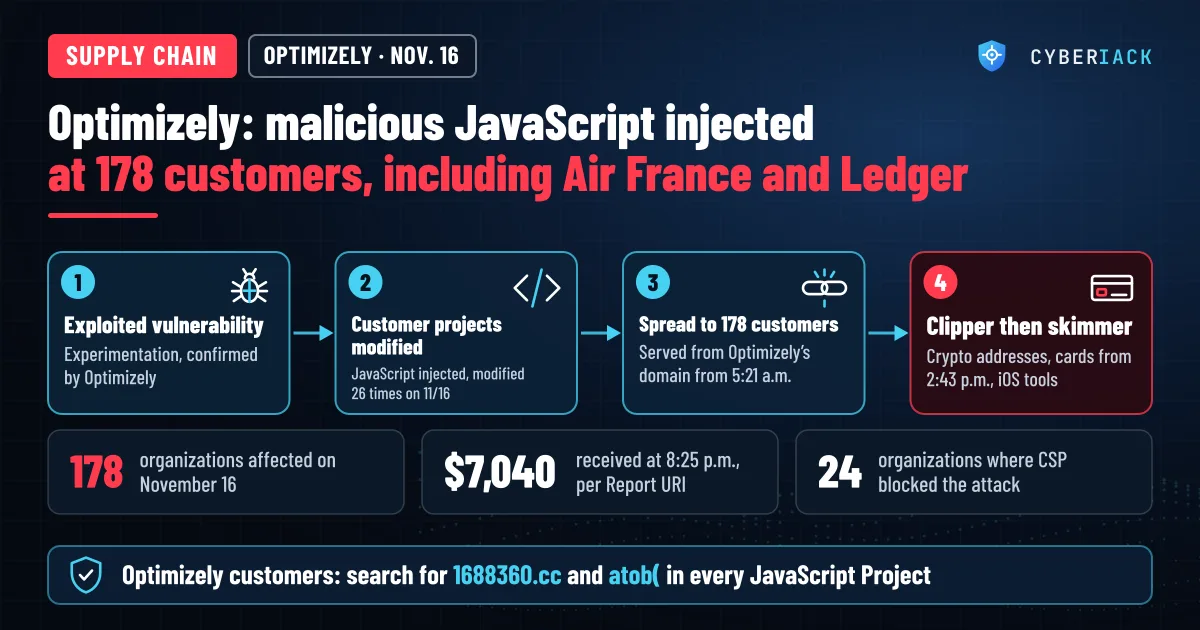
On November 16, an attacker exploited a vulnerability in Optimizely Experimentation to inject malicious code, first a cryptocurrency clipper and then a card skimmer, into the scripts of 178 customer organizations, including Air France, KLM, Transavia and Ledger. Optimizely says it has fixed the vulnerability. Its customers must audit their projects and promptly assess whether a personal data breach has occurred.
The facts
- November 16, 5:21 a.m. (Paris time): the code is first detected in the BBC's Optimizely script, then at 177 other organizations. Report URI finds it in 188 of the 1,611 scripts it examined, a figure that is probably underestimated according to Scott Helme.
- November 17, 2:02 a.m.: Optimizely confirms that an unauthorized third party exploited an Experimentation vulnerability to add malicious JavaScript to customer projects, and says it has fixed the flaw, removed the code and secured the affected accounts. According to Next and StepSecurity, citing Gizmodo, the vulnerability was in the sign-up flow.
- Payload, modified 26 times according to Report URI: replacement of copied wallet addresses (bitcoin, ether, solana and five other networks); starting at 2:43 p.m., capture of the number, expiration date and security code of cards entered in the sites' forms, excluding fields in a payment provider's separate iframe (Stripe, Adyen); exfiltration of some cookies and screenshots; on iPhone and iPad, loading of the Coruna and DarkSword attack tools, delivered according to StepSecurity without any device compromise being established.
- Amounts: about $7,040 received by the attacker's wallets at 8:25 p.m. according to Report URI, about $2,300 according to Alex Thorn (Galaxy Digital). Hudson Rock could not link these transfers to visitors of the affected sites.
- Cleanup: most scripts between 9:40 p.m. and 10:10 p.m., all by 12:11 a.m. on November 17 (Report URI). Neither Air France-KLM nor Ledger had responded publicly in the sources consulted.
- Prior activity: according to Report URI, the same injector went through Kissmetrics, StorifyMe and Minute Media as early as November 13, and had been seen on Turkish sites in September. No attribution at this stage.
Impact
Exposed are the Optimizely Experimentation customers whose project served the code, and their visitors on November 16; Report URI's list also names ABN AMRO, Thales, Imperva, IKEA and ASOS. A site that collects cards in its own forms must investigate a personal data breach, to be notified to the CNIL (the French data protection authority) within 72 hours unless the risk is unlikely, even though the number of exfiltrated cards remains unknown.
The attacker did not have to break into Air France or Ledger; they modified a script that those companies' pages loaded from an authorized domain. Two protections held: the payment provider's separate iframe card fields, and a restrictive CSP, which blocked the attack at 24 organizations, or 15% of those assessed by Report URI. Optimizely has not explained how the vulnerability gave write access to other customers' projects; isolation between customers must be part of the assessment of any vendor that injects code into pages. The technique recalls the booby-trapped speed measurement tool on Polymarket.
Recommendations
- Inspect the “Project JavaScript” field of every Optimizely project, searching for
1688360.ccandatob(. - Review Optimizely accounts and access tokens, then rotate any secrets stored in unprotected cookies.
- Identify the card pages and forms exposed on November 16 to decide on notifying the CNIL and informing affected individuals.
- Pass on to exposed customers the published advice: monitor cards entered that day, or even have them replaced (StepSecurity); verify the destination address on the hardware wallet screen; upgrade to iOS 18.7.3 or later, or to iOS 26.3 and above (Report URI).
- Enforce a restrictive CSP on sensitive pages and delegate card entry to the payment provider's separate iframe fields.
- Inventory the third-party scripts loaded by your pages, including Kissmetrics, StorifyMe and Minute Media, and detect any change to their content.
Method: facts verified against the sources cited below, article reviewed and approved by Frédéric LENQUETTE. Our editorial policy.
Share this article


